We Need a New Product Hunt
Product Hunt is dominated by big-company marketing, not aspiring makers.
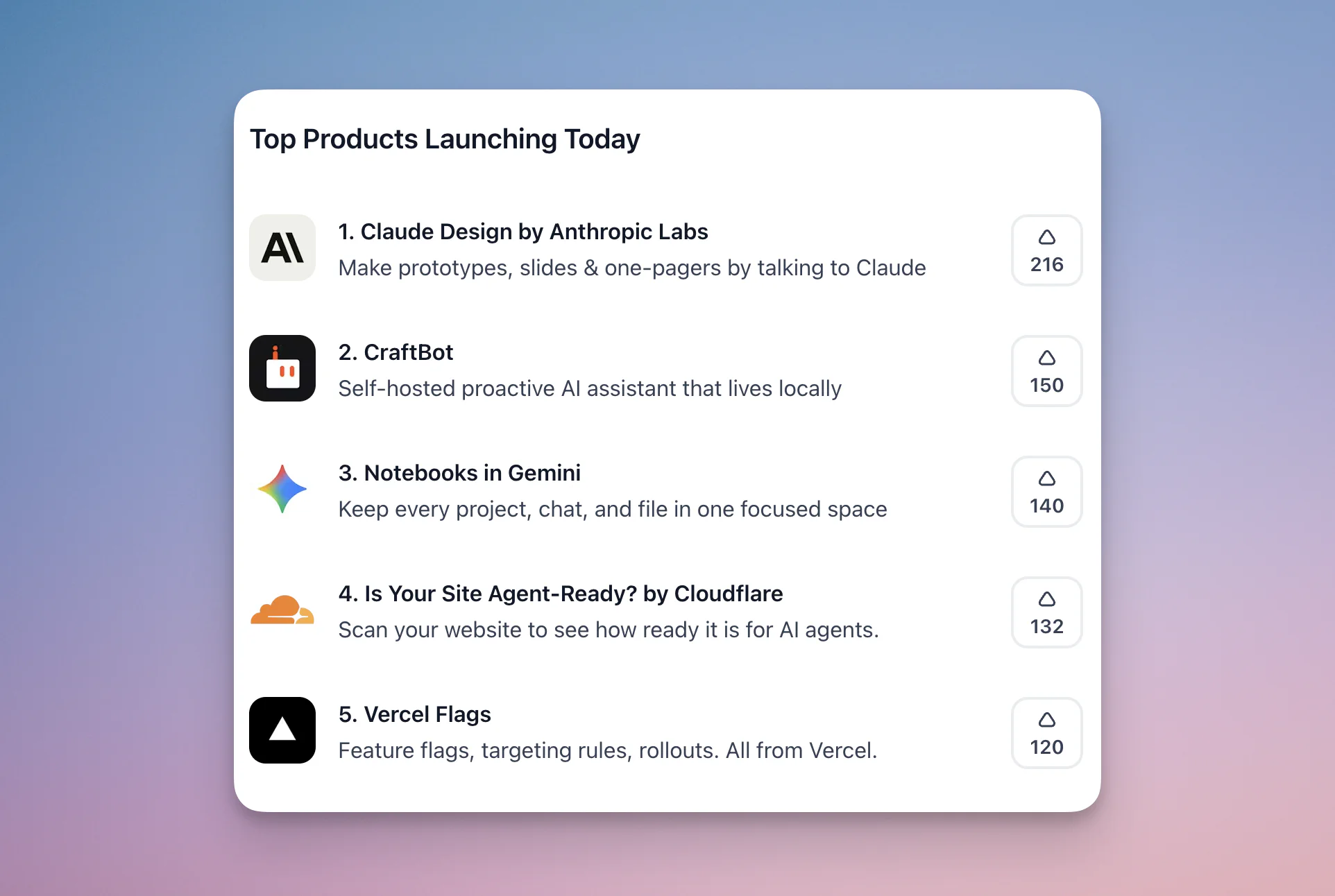
This is Product Hunt’s main page today. 4 out of 5 places are taken by extremely large companies that need little promotion: Anthropic, Google, Cloudflare and Vercel.
Product Hunt used to be a website I opened daily looking for cool new products. Some of them were just nice personal tools and some eventually grew into billion-dollar companies (I found Truebill there during their launch). But since then, it has turned into a marketing platform for big tech startups. Sometimes it’s genuine products, but more often than not, it’s mundane updates grouped under a “Pied Piper 2.0” or just the most basic features.
The only thing that matters is how much attention you can manufacture around the vote. There’s an entire industry around ProductHunt. Infinite guides, professional “hunters”, workflows to ensure you will get hundreds of upvotes right away just so bystanders could organically see you and start voting. Founders and marketing teams plan it for weeks and blast across all of their channels on the day.
So I stopped opening Product Hunt years ago because I rarely saw anything interesting anymore. A true indy project has little hope. Which is why we need a new Product Hunt.
Product Hunt started in November 2013 as a scrappy side project by Ryan Hoover. He liked browsing App Store charts in other countries and exploring AngelList to see what people were building (I get that feeling) but there was no single destination for discovering the new product launches. Product Hunt initially launched as an email list and later turned into one of the main niche tech websites and grew until AngelList acquired it in 2016 for $20 million. It is still the default launchpad for new tech products, which are accelerating even more with agentic engineering.
What changed the most is the ecosystem. Back then, the information was scarce and products were rare. ProductHunt could legitimately serve as the hub for all the day’s key product launches. It was never the only choice even then. Hacker News: Show was an early inspiration, and there were true alternatives like Betalist and many others. But none of the alternatives have been able to elevate the launch into a separate event.
Right now, we’re drowning in new companies and products. Not a day goes by that people aren’t hyping up yet another thing that is bound to replace the previous thing. Aggregating all of them is a futile exercise because what matters is not the discovery but curation. Any catalog built around voting will inevitably attract the same marketers that Product Hunt suffers from. As long as it’s about the headcount and attention, large companies with social media presence will always win. Which leads us to the question: can we even have a new Product Hunt?
One particular change that could fix this problem is tying the product to the company. Imagine that you could submit your company only once. Have another product? Feel free to post about it, but it won’t take a slot. Then neither Google nor Vercel would compete with indie developers. Makers could break through, and marketing teams won’t be able to repackage their existing products countless times. You could also go authoritarian and limit who can vote, though Product Hunt already prioritizes old, verified users over new signups, especially on launch days.
The more I think about it, the more it seems that we will never have a true replacement. But what we can have is individuals and communities curating their app collections. This removes the promotion issue altogether. It adds other issues, most importantly about access — as a founder, you can’t post your project on someone’s blog. You need to make the authors interested in some way.
We’re shifting from a centralized directory to a fragmented ecosystem of tastemakers. And the biggest problem for consumers is finding the people to follow.
I watch A Better Computer, an awesome channel by Matt Birchler, who figured out there was an almost unoccupied niche in talking about software and not gadgets on YouTube. I discovered and subscribed to MacStories because they took a very different route compared to most Apple-centric websites and focused on unique apps. I also subcribe to Internet is Beatiful, which shares hidden internet gems along with useful tools and products. There are niche subreddits on all sorts of topics related to computers.
Maybe one day, one of these platforms or another will become a new Product Hunt. But I’m doubtful for the same reasons I outlined earlier. Most likely we will just have no tech monoculture anymore apart from the Twitter timeline. The algorithm will decide whose launch everyone will see tomorrow.