How Linear Turned Craft Into a B2B Growth Strategy
Linear’s founders hated the project-management software they used at Airbnb, Coinbase, and Uber. So they built a faster, more opinionated alternative, turned craft into a company philosophy, and made their product a status signal for ambitious software teams.

Linear is an opinionated project management platform designed for high-performing software development and product teams. It was built as an opposition to JIRA, the “most hated software” ever created.
In the survey by Gergely Orosz, Jira ended up as the most-disliked tool with more negative mentions than the next four combined. This happens a lot with enterprise B2B software because the decision-makers and users are different people. C-level executives decide to buy the tool that everyone else has to use, often for budgetary reasons. It’s how people end up with Microsoft Teams instead of Slack even if everyone despises it a little bit.
Linear’s founders had encountered this issue at Airbnb, Coinbase, and Uber. They believed that project-management software had been designed around bureaucracy rather than the people building products. They discussed the idea every Wednesday for roughly a year while still employed. In March 2019, they quit their jobs, built a working prototype in about a month and gave it to ten friends.
Seven years later, Linear has more than 20,000 paid business customers. Its latest disclosed $82 million Series C valued the company at $1.25 billion in June 2025 with only 118 employees. Even its landing-page design became influential. The dark hero, gradients, precise typography, and small flashes of purple-blue light were copied so widely that “Linear-style” became a meme around 2021-2023.
The question of how Linear built such a cult following and reputation has always interested me. Many teams cared about the craft and produced beautiful apps. Few have become so influential. So I’ve tried to figure it out.
I. How they started
Karri Saarinen first tried to improve Jira from the inside. While working as a principal designer at Airbnb, he built a Chrome extension that restyled its UI and over 100 colleagues installed it.
Saarinen had previously co-founded the bookmarking startup Kippt with Jori Lallo, gone through Y Combinator, and sold the company to Coinbase. He became Coinbase’s first designer and later led Airbnb’s Design Language System. Lallo had built Kippt with him and joined Coinbase as an engineer. Tuomas Artman had run a development agency, worked in engineering management at Groupon, and spent five years at Uber, eventually becoming a senior staff engineer on its mobile platform.
One month after leaving their jobs, the founders published “Announcing Linear”, tweeted about the company, and opened an email waitlist. The text starts with a very powerful phrase that explains the value of what they’re building.
Managing software development and design well is one of the most critical activities of any product company.
Then, they proceed to prove their expertise and vision.
Something that really frustrated me at Airbnb, and many other companies I’ve worked at, is how bad a lot of exciting tasks/project/issue tracking tools were. Usually, every team and company started with a quite casual way of managing work, but later needed some tracking system, and often ended up using something like JIRA. I could see how the team motivation sank and how much time the team wasted arguing against it. Eventually, people give up, since they have to use something and there aren’t any great options really. For me using these tools, as a designer, I was surprised how badly they were designed. <…> If these tools don’t work well for designers, engineering or even the management, then who do they work for?
Ten days later, Saarinen also published “Starting Linear” on his personal site, which shared his departure from Airbnb and repeated his observations on how adopting Jira ruined the teams’ motivation to perform and do great work.
The argument there was simple:
- Development tools had become slow and fragmented.
- Their workflows remained attached to old Agile and Scrum conventions.
- Linear would prioritize speed and strong user experience, automate manual work, and connect planning more closely with execution.
Linear had an unusually developed story right from the beginning. They explained what they’re building in exact detail, why it’s important, and why their company will be important. And right away, they had an enemy in Jira. Having a clear enemy is the easiest comms hack you can think of. You punch up, look great and can explain yourself in three words.
II. Solving distribution
Linear was able to secure those early signups because the team was already known in the design and tech communities. In addition to his roles at Coinbase and Airbnb, Saarinen authored Airbnb Design essays, there was a 2017 Figma article about his design-systems, he did the Designer News AMA, the Design Details podcast, some Google Design coverage, and various conference talks. This drove designers, engineers and executives to become his followers and gave the needed credibility to their claims.
Sequoia partner Stephanie Zhan later recalled seeing people she trusted express excitement about Linear on Twitter, even though she did not follow the founders. So Sequoia contacted them two days later, Saarinen assembled a deck the night before the meeting, and Linear raised a $4.2 million seed round. It was covered by TechCrunch; in addition to Sequoia and Index they had a great roster of angels, like the CEO of Figma. The story is unusually extensive for a 2019 TechCrunch and extremely positive, mostly mirroring Linear’s early messaging.
The app stayed behind a waitlist for almost a year. Linear used its signup survey to ask about role, company size, current tools, and specific frustrations. The founders selected small tech companies whose problems matched what their incomplete product could solve.
Meanwhile, Linear kept creating new events to attract attention. It published weekly product updates, started a feedback channel and an early community, launched on Product Hunt, and announced an integration with Figma.
By May 2020, Linear produced more than 50 changelogs in 12 months. Saarinen explained the practice in “Startups, Write Changelogs”. The team initially wanted to demonstrate to early adopters that the missing features and bug fixes would arrive quickly but they noticed far more benefits than this, including the team’s morale.
A changelog is a simple way to communicate your progress and culture and celebrate wins. It can be a quick way to align your team to focus on creating user value.
These changelogs also provided endless screenshots and videos for Twitter and newsletters, sparking outside conversations.
During its public launch in June 2020, the company explained their approach to building products and named it the Linear Method. One key and somewhat obvious idea there was that a startup does not have one launch. You can launch the company, a private beta, public access, pricing, integrations, redesigns, new product surfaces, and changes in direction as chapters of a single story. Obvious, but not every company actually does this.
Linear’s own presence on Product Hunt is a perfect example. Their original September 2019 listing got only 61 upvotes and reached #30 for the day. But their June 2020 public launch listing reached #1 and won a Golden Kitty, and the announcement itself started an extensive Hacker News discussion.
You might have noticed that a lot of the ideas we mentioned aren’t really about communications. It’s about the product, updates and the founders’ pedigree. That’s how it always works.
By the public launch, Saarinen estimated that Linear had accumulated roughly 10,000 email addresses and had around 1,000 daily active users, according to First Round’s account.
III. From speed to magic, purpose, and craft

In their seed announcement, the founders said that Linear wanted to bring “magic” back to software.
We want to bring some of the magic back to computers and software.
The word “craft” first appears at the end of their Series A announcement in December 2020.
Let’s make software as a craft feel magical again.
This language helped Linear solve a huge product-marketing problem. Many of its early differentiators sounded small on paper: shortcuts, offline support, fast search, cleaner defaults, animations. But together they created a markedly better experience. Craft gave those details a common cause.
The language continued to evolve. Storytelling lead Julian Lehr says the team spent roughly three years arriving at “purpose-built.” “Opinionated” described Linear’s behavior but could sound inflexible. “Purpose-built” expressed the customer benefit: the product made deliberate choices because it had been designed for a specific kind of team and work. Not everyone. But the people who use it truly enjoy Linear.
You might discount the value of caring about words that much, but Julian said something that resonated with me on that podcast:
Stories are a data compression algorithm that takes all of that complexity and summarizes it and packages it nicely in a very easy to consume, compelling narrative.
Even after Linear discovered the unique design and features, it took them time to find the right language to explain it.
IV. Linear’s unique positioning
Linear did not invent craft as a concept applied to software. Things 3 had shown how much loyalty a meticulously designed productivity app could have. Superhuman rebuilt email around speed and keyboard control. Basecamp’s founders published an entire philosophy of simple, opinionated project-management software. Asana’s founders explicitly promised consumer-quality design and delightful interactions for enterprise users.
Most of these companies had one of two problems:
- Either the product targeted very niche audiences and specific market segments
- Or they targeted everyone, forcing the product to evolve, get bigger, more complex and eventually turn into a behemoth it promised to destroy
Customers always ask for more features, workflows, permissions, integrations, views, automations, and controls. Enterprise contracts bring specialized requirements. Nobody would describe modern Asana as light. Monday.com built an enormous business by allowing almost any department to configure almost any workflow. Jira built features required to support any organization with thousands of employees. As these products became more capable, they also got unpleasant.
Linear started with a deliberately narrow focus on software development teams. It then expanded by covering more features for the same audience. Linear added more of the product-development lifecycle instead of becoming a general productivity platform. Issues led to cycles, projects, roadmaps, customer requests, analytics, and planning.
The approach gave Linear the reach of a mass-market business application inside a specific professional market. One engineer could introduce it to an entire product organization. Designers, product managers, support teams, and executives would then experience the same system.
Still, even Linear could not escape the fate of other apps. But they reacted to this much more aggressively by doing a complete redesign to clear the “debt.”
In 2024, Saarinen publicly admitted that the company’s habit of shipping small changes daily and major features almost every week had produced design debt. In “A design reset”, he argued that fast-moving products should pay this debt every two or three years. Otherwise, user sentiment gradually deteriorates, the product begins to resemble a “dinosaur incumbent,” and a more focused competitor gets the opening Linear once found against Jira.
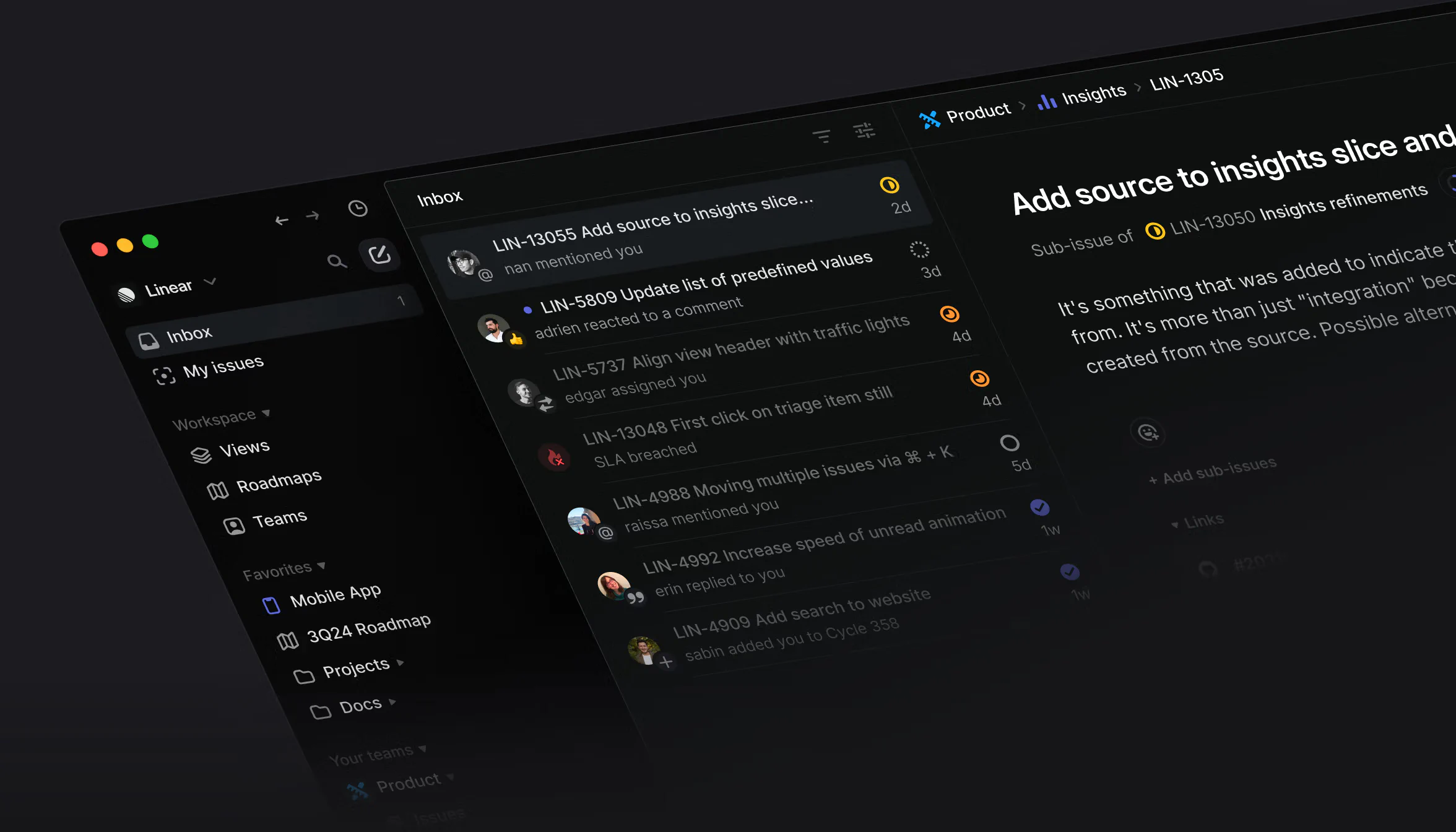
An unusually revealing admission from a company whose positioning relied on design. Linear did a near-complete redesign and reduced its theme system from 98 individually defined variables to three foundational controls: base color, accent color, and contrast. The company tested the new interface internally, released it through a private beta, and gradually expanded access across workspaces. The implementation took just about six weeks.
People think of craft as the quality of a finished object. But software never gets finished. Either it becomes irrelevant or evolves, but adaptation threatens the coherence that made it appealing in the first place.
One way to look at successful startups is that every one of them is unreasonable about something. For Linear, it’s the design. They were and are willing to go further than anyone and disregard the metrics and resources to have the best-feeling app for their users.
V. From a tool to a status signal
Enterprise software is usually marketed to executives who control the budget. Instead, Linear adopted the bottom-up approach and targeted the engineers, designers, and product people expected to use it. The first funding announcement mentioned several early customers like Pitch, Render and others. Ramp had adopted Linear in October 2019, when the company had just five employees.
Linear did a big push with their “Fast growing startups are built on Linear” post in 2021, which named Descript as their customer. Founder Andrew Mason described his team as fighting “work about work” in its old issue tracker and praised Linear.
Each funding announcement was used to advance the narrative. By the 2023 Series B, Linear had Cash App, Supercell, The Browser Company, Raycast, Retool, Vercel, Cohere, Substack, Mercury, Runway, Loom, and Ramp among its customers. Several customer founders, including the leaders of Vercel, Supercell, The Browser Company, Descript, and Mercury, also invested in this round.
These were widely admired companies inside the professional community. Adopting Linear could now signal that a company cared about the people building its product. It created a cultural belief that this team took product quality seriously.
Linear used its operating results to validate the philosophy. The 2023 round led to their profile story in Forbes by Alex Konrad. It was pure recognition, because they had a lot to brag about:
Linear’s been profitable for the past two years, Saarinen said, while spending just $36,000 on marketing and, until recently, employing just one salesperson. Linear has more money in the bank today than it’s raised from investors, a negative net burn that’s rare for a fast-growing young tech company.
Don’t take this number at face value. Besides these two podcast sponsorships, Linear invested heavily in founder time, product presentation, launches, community, content, media, and an internal creative studio.
The 2025 Series C, now covered by Reuters and TechCrunch, repeated the pattern, placing more than 15,000 customers, profitability, restrained hiring, and a $1.25 billion valuation.
Linear said its profits grew 280% last year, and it now has over 15,000 customers, including buzzy AI companies OpenAI, Scale AI and Perplexity. <..> The 80-person, remote-first company will use its funding to build more products and attract larger enterprises to its customer base, said CEO Karri Saarinen.
Business press were used to explain the company for a wider market and for added credibility for less niche buyers. But Linear didn’t stop there.
Specialist media were emerging right around their early years. They allowed Linear to talk to a vast array of their potential users directly through trusted intermediaries that product people, designers and engineers followed.
The Lenny’s Newsletter profile and accompanying YouTube interview packaged Linear’s practices into a management story and once again demonstrated their commitments to taste over metrics. This is their story for product people. Then, the CTO gets interviewed for The Pragmatic Engineer’s piece that reaches engineers. And they reached designers through a piece on Figma’s blog. These long-form interviews gave executives enough room to explain provocative practices in detail without reducing them to slogans.
VI. Building communications like a product
 As the product expanded, Linear needed to produce more launches, pages, films, and essays without losing the cohesion. To do this, Linear built an in-house creative studio.
Julian Lehr discovered Linear during its private beta and described it in an essay as “Superhuman for issue tracking.” Jori Lallo, Linear’s CPO, read the piece and later recruited him to lead storytelling: a deliberately open title to avoid defining the role around standard outputs such as webinars and customer cases. Instead, they wanted to find a new expression for each idea.
Lehr’s first major project was the Linear Readme. The goal was to create recruitment material, but it behaved like a product launch: a three-act manifesto about creators, distraction, sameness, and the decline of software quality, built with intricate design and animation. It attracted the front-end engineers and designers Linear wanted to hire while reinforcing the worldview it sold to customers.
More people joined him. Lehr says the studio grew to six people across brand design, design engineering, and storytelling so they could produce essays, launch films, interviews, websites, product demonstrations, and social posts all on their own.
Lehr also describes a software website as packaging for a product that cannot be held. The words, layout, motion, spacing, and interaction have to make an intangible system feel coherent before a visitor creates an account. At Linear, copy and visual design developed together; writing was treated as part of interface design.
Anyone could copy Linear’s website. One time Karri even called out the company who did it the most egregiously. But few could reproduce the quality of their app and the demand for it.
Conversations on Quality shows how far the mandate extended. Linear interviewed external builders such as Dick Costolo, Jeff Weinstein, Basheer Tome, and Ethan Eismann about quality. The films rarely needed to sell the product directly. They let Linear occupy an editorial territory, associate the company with people admired by its audience, and make “quality” larger than an issue-tracking feature.
The studio’s job was to translate Linear’s worldview into different forms of evidence. To do this, the company expanded its spokesperson bench. Saarinen remained the theorist, arguing for taste over metrics and company building as craft. Artman explained how their technical approach to architecture and intolerance to latency made the product work well. Product leaders like Nan Yu discussed scopes and strategy. Engineering managers described work trials, small teams, and weekly support rotations.
VII. Lessons from Linear
Several broader lessons follow from Linear’s communications:
- Keep launching. Repeated, connected releases let a company accumulate attention and update its position as the product expands.
- Put the claim in the product first. Linear could talk about quality because users could feel it in the product
- Create your own vocabulary. Magic, the Linear Method, their extreme attention to carefully chosen words like “purpose-built” and “craft” turned dozens of small decisions into their branding.
- Choose customers others want to resemble. Admired startups made Linear a status signal among the users and customers.
- Make constraints look intentional. Strong defaults, a small team, restrained hiring, and little paid advertising could be a sign of an inflexible product that doesn’t grow — or become the interesting bit in your story when all the metrics are up.
VIII. Can craft survive the death of issue tracking?
Linear is now attacking the category it helped rebuild.
In March 2026, Saarinen declared that “issue tracking is dead”. Coding agents can now compress planning, implementation, and review into a single step. Linear’s proposed replacement is Linear Agents, the “shared product system that turns context into execution.”
Just like with their 2019 launch, Linear found a thing that has become obsolete and wants to build an alternative. But now they’re both the incumbent and the challenger.
And the only things that Linear might keep in the end are its team and goodwill. Agents do not care about design or keyboard shortcuts. Seat-based pricing doesn’t make sense for them. And automated output complicates the very idea of craft, when Linear spent years celebrating the judgment and care of individual contributors.
According to Linear, this means that craft moves from manually producing every artifact to deciding what should exist, supplying the right context, and judging whether the result deserves to ship.
Linear’s original promise was that work software did not have to feel like Jira. The company made quality into a growth strategy by building an unusually delightful system for producing human-made software at scale. Its next promise is more ambitious: software built at machine speed does not have to become careless.
Sources
I used publicly available sources and my own analysis for this write-up.
Linear and founder sources
- Announcing Linear
- Karri Saarinen: Starting Linear
- Linear: Startups, Write Changelogs
- Linear is now open for all
- The Linear Method
- Linear Readme
- Conversations on Quality
- Building our way: Announcing our Series C
- Issue tracking is dead
Company-building and product interviews
- First Round: Linear’s path to product-market fit
- First Round: Inside Linear—Why craft and focus still win
- The Pragmatic Engineer: How Linear builds product
- Lenny’s Newsletter: How Linear builds product
- Sequoia: Linear—Designing for the Developers
- Mercury: Tuomas Artman, designing surprising tools
- Figma: The Linear Method—Opinionated software
- Figma: Karri Saarinen’s 10 rules for crafting products that stand out
- Julian Lehr: How storytelling works at Linear
Funding and business coverage
- TechCrunch: Linear’s $4.2 million seed
- Forbes: Linear’s $35 million Series B
- TechCrunch: Linear’s $82 million Series C