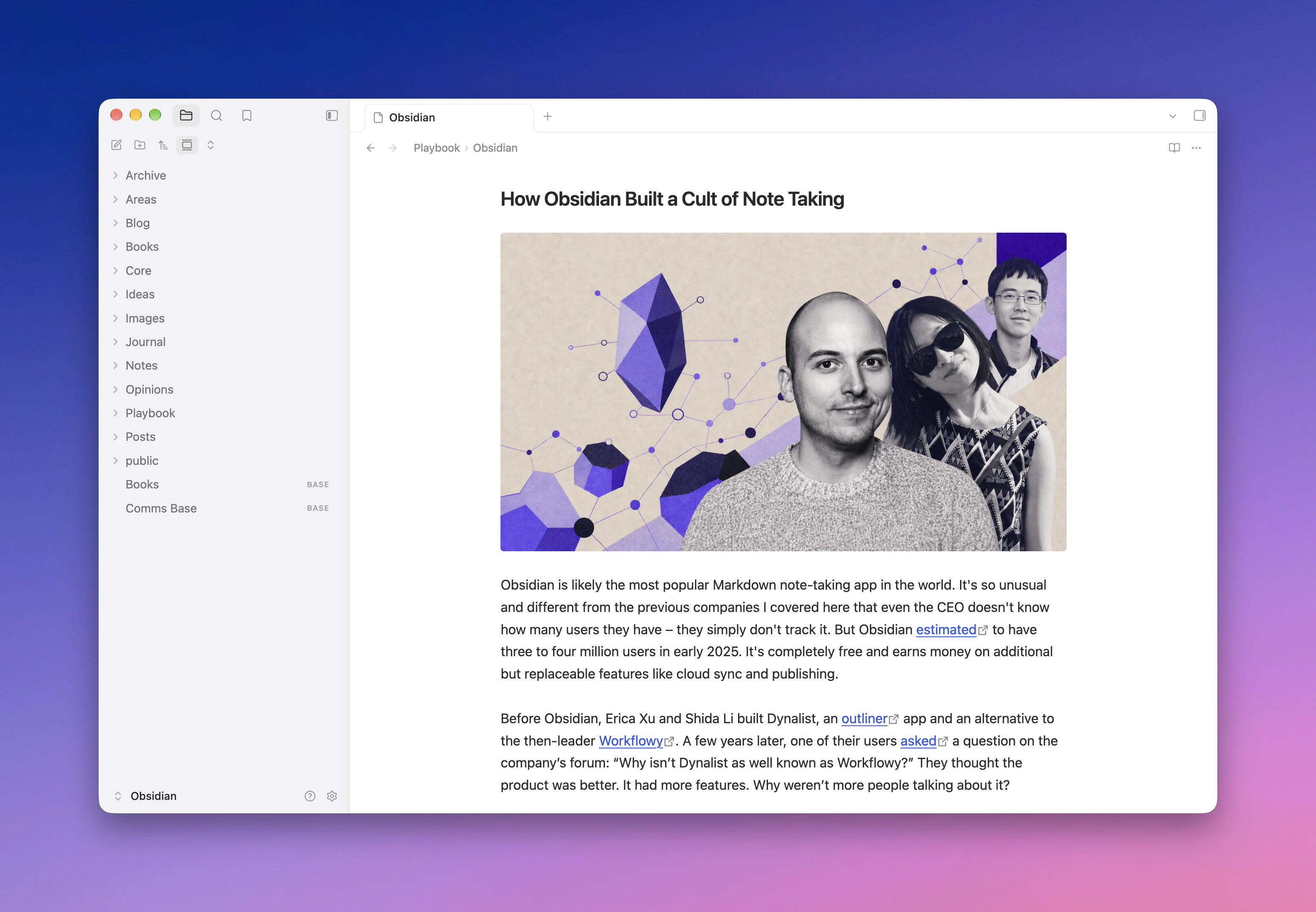
How Obsidian Built a Cult of Note Taking
Obsidian turned local files, a growing obsession with note-taking, and users who made the app their own into a devoted following and an independent business.

Obsidian is likely the most popular Markdown note-taking app in the world. It’s so unusual and different from the previous companies I covered here that even the CEO doesn’t know how many users they have – they simply don’t track it. But Obsidian estimated to have three to four million users in early 2025. It’s completely free and earns money on additional but replaceable features like cloud sync and publishing.
Before Obsidian, Erica Xu and Shida Li built Dynalist, an outliner app and an alternative to the then-leader Workflowy. A few years later, one of their users asked a question on the company’s forum: “Why isn’t Dynalist as well known as Workflowy?” They thought the product was better. It had more features. Why weren’t more people talking about it?
Erica Xu replied that Workflowy had five-year head start, venture funding and backing of Y Combinator. Dynalist was bootstrapped and grew slower, mostly through word of mouth. Another user wished someone would promote Dynalist with the enthusiasm that bloggers and video creators brought to Workflowy.
Eventually, Xu and Li would get the advocates those users wanted. Obsidian was their second attempt, and with it, the founders have found a much more interesting product people immediately wanted.
Obsidian works on a folder of Markdown files on your computer. You can link notes together, visualize their relationships, and install plugins that change how almost anything works. And since these are just plain files, any other app can read them. You’re not a hostage. And a lot of people liked this idea.
Xu once described Obsidian as an “IDE for thought”, which is a good albeit loaded explanation. IDEs are advanced text editors used by software developers which provide a lot more functionality to help them write and edit code. They have a learning curve but the people who are used to them don’t want to go back. Same with Obsidian.
Naturally, this newsletter was also written in Obsidian.
I. Starting again after Dynalist
Xu and Li started Dynalist in 2015. I remember comparing it to Workflowy back then before deciding which one to choose: both looked quite similar. One of their early blog posts was literally titled “Isn’t Dynalist just a WorkFlowy clone?” and they explained what they believed were the biggest differences, including certain UI decisions and long-term vision.
I love outliners very much. I used Workflowy for many years and even wrote a guide to it. But it’s a difficult software category most people don’t get. And with Dynalist, just like with Workflowy, you had to understand outliners first and like their unique approach. So mostly, they competed for the users of other outliners.
Obsidian began with a different problem. Xu had wanted to create something like a personal knowledge base for about two years, trying obscure tools like a private instance of MediaWiki and TiddlyWiki. After seeing more and more note-taking and knowledge-management posts on Hacker News, she realized other people had the same need.
They presented Obsidian as a new, separate product for writing and revisiting notes. Original Dynalist users asked what is the difference and whether it had to be a brand new app around the May 2020 announcement, to which they replied:
Obsidian values connections more, whereas Dynalist values structures more.
They now targeted a wider potential audience which included people writing books, or building an archive of all the things they had learned. This turned out to be a big audience.
II. The Second Brain boom
Obsidian arrived during a very unusual moment in productivity app culture around the end of 2010s. People were learning and building elaborate systems for taking notes, paying expensive subscriptions for the software to run them, and buying courses to understand how it all worked. Building a “second brain” became a project in itself for some.
Some of these system were truly complex, like Zettelkasten, which grew out of a tradition of organizing knowledge through individual ideas split across slips of paper. German sociologist Niklas Luhmann developed his own elaborate version, using a system of numbering and cross-references to connect his notes. Sönke Ahrens’s How to Take Smart Notes introduced that practice to a modern audience of readers and writers. Separately, Tiago Forte began teaching Building a Second Brain , sharing his method for collecting useful information and turning it into finished work. All united around the idea that accumulating knowledge could lead to something new.
The high-level concept and justification for this was that instead of spending all day reading articles, highlighting books, and saving links, you were investing in your own intelligence. A great new system could help people recover that wasted effort. Your past reading could help your future self think.
The interested audience grew quickly. Forte reported 1,083 new students in 2020, despite tripling the course’s price; roughly 1,500 had taken it across the preceding nine cohorts. By March 2023, his subsequent book had sold 100,000 copies in the US and UK.
The peak of the Second Brain movement was Roam Research, an advanced outliner app with backlinks. Typing wiki-style double brackets would connect ideas across your notes but they’d also list the notes that linked to the current one. Roam seeded the idea that even a rough productivity app could charge $15 a month for a unique workflow and attract power users; it even had a $500 fiver-year “Believer” plan. It attracted some of the best investors like Chapter One, True Ventures, Village Global and others and raised $9 million at a sky-high $200 million valuation. Founder Conor White-Sullivan became a speaker on collective intelligence and the limitations of existing institutions.
But eventually, the novelty wore off. In “The Fall of Roam” published in February 2022, Dan Shipper described spending time creating links that he rarely revisited. The initial relief from wondering where to put a note had faded, and once that happened anxiety returned, while Roam’s shortcomings in search, mobile access, and development became harder to overlook. Dan had moved much of his work back to simpler tools.
One of the more polished alternatives was Mem. In March 2022, it announced Mem X, a $10-a-month service that would use AI to organize information and find related notes, alongside its free core product. While Roam focused on manually building connections, Mem promised to take some of that organizing work off your hands. It seems to have lost most of its allure and recently pivoted to being your “AI Chief of Staff”.
This is the productivity gold rush that Obsidian entered. On April 3, 2020, the founders introduced it on Reddit as a “future-proof Markdown note-taking and personal knowledge base app”, and shared access to a private beta. When asked how it compared with Roam, the developers pointed to the ownership of the files: “your files would outlive your software”.
People specifically recommended the app on the Zettelkasten forum because it came from Dynalist’s makers. Among those asking for access was Nick Milo, who would later teach people to use Obsidian through his Linking Your Thinking videos and courses.
The public beta launched on May 27, 2020, through Show HN and Product Hunt. The Hacker News title called it a knowledge base working on local Markdown files. Xu said that the team already had more than 5,000 beta testers and had told the community about the launch. The thread now records 1,087 points and 477 comments. Yours truly commented right there:
Obsidian is one of the best apps I discovered recently and almost immediately become a core part of my workflow despite its early stage.
Many people who used Roam or others app were interested in a free and future-proof alternative. Each Roam’s problem gave them a wave of refugees. Later, Li specifically recalled users switching after Roam’s data-loss incidents and pricing changes. Sönke Ahrens moved from Roam to Obsidian and started teaching his course using it.
Obsidian used that unique opening to create a cult following. Three separate things likely helped this happen.
First, the core app was free for personal use. Trying an elaborate system already required time and effort but Obsidian removed the barrier of the subscription. Educators could recommend it to their entire audience, increasing the pool of potential teachers, plugin developers, and people answering questions.
Second, free use came with local ownership. Even if some apps like Mem had a free tier, you still depended on a hosted service that could change pricing, features, or shut down. Obsidian’s installed app and ordinary files would remain usable forever.
Third, Obsidian could accommodate different methods. Folders, daily journals, linked essays, and a strict Zettelkasten could coexist. Plugins let people add the behavior they wanted. The founders didn’t have strong feeling about how people must use it. Obsidian users could overcomplicate their systems too, but they could also strip them back and keep writing in the same files.
Obsidian would remain useful even after a user lost interest in perfecting their second brain.
III. Building a community

The private alpha builds were distributed exclusively through Discord. You had to become a part of the community first to get the software.
Li chose Discord because he moderated a gaming community before and believed in the the value of a shared space where users could reach the developers directly. People came for the app but stayed to give feedback and to chat with other users.
The team initially collected bug reports and feature requests through a Discord bot called Carl the Turtle. By the end of private beta, it had more than 1,000 suggestions. They launched a Discourse forum to move this backlog and make it easier to search and discuss specific ideas.
One of the best unintended tools became the graph that showed all the connections between someone’s nodes in Obsidian. What made it great is the fact you could share your graph without showing all your private notes. It was like a badge of honor and users “competed” to show the most elaborate and complex collection.
The founders also took notice of what users were doing and created spaces for it. People shared graphs, so they created a channel for graphs. People discussed their knowledge systems, so they created a channel for that. Active and helpful users became moderators.
The public API arrived in October 2020 and allowed developers to build functionality without waiting for the team. Many internal features were rebuilt as core plugin which provided great flexibility: you can disable even them if you don’t need it. Plugins also gave users another way to contribute: every useful extension would generate its own tutorials, demos, and recommendations.
Milo’s Linking Your Thinking paid course showed that an educator could build a business around helping people use a free app. Other users built an ecosystem of newsletters and commissioned plugins: Eleanor Konik published a newsletter, while MacStories writers paid to have extensions built for their workflows. And even though Tiago Forte himself didn’t like Obsidian, many of his followers chose it for their second brain.
Each contributor had a reason to keep producing material while helping the company acquire users. Developers could built a reputation for a useful plugin; writers could publish setups other people wanted to copy.
The company encouraged this through its own announcements. The 2023 Gems of the Year awards, announced in January 2024, recognized content and templates alongside plugins and themes. This award gave contributors recognition and supplied a recurring editorial event built around their work.
IV. The community supplied a CEO
Steph Ango, better known online as kepano, is the current CEO of Obsidian, but not one of the founders. Like many things in this project, he was also “provided” by the community. Steph was an early used who already recommended in the Obsidian in its May 2020 launch thread, praising the local files, customization, and speed of development. Through Discord, he got to know the founders, discussed bugs and improvements, and eventually helped create “Minimal”, the default theme for the version 1.0 and after.
In February 2023, he became the CEO. After reiterating his contributions, he shared his vision about what made Obsidian great and would continue: free use, durable open formats without lock-in, privacy and offline access, and customization through APIs and plugins. For Sync, privacy included end-to-end encryption.
The founder being replaced by a new CEO can be scary. The announcement pre-empted the concerns by showing him as an active member of the community and a fan of the app. Most users were happy and excited about the change.
Obsidian has always been text-centric but with Ango, essays become one of the ways to communicate the app’s mission. His July 2023 essay “File over app” gave a simple name to their approach that sounded (and worked) like a slogan for a simple idea: digital work should survive the software used to create it.
The beauty is that this principle could travel beyond note-taking. Someone could apply it to photographs, writing, or design files and write their own blog posts or tweets. People could agree or disagree with Ango and write their own essays even if they never used Obsidian, but would still spread the word about it, even if indirectly.
Ango puts a lot of work into helping his ideas travel. He tries to make them quite short, ideally up to 500 words, and unusually, often gets back to rewrite his older pieces. When he felt Twitter made links harder to distribute, he began posting screenshots of his essays and chose a consistent color palette so readers could recognize them in the feed.
With Steph, Obsidian got a public voice with a body of work that could support interviews and discussions on a multitude of topics, including design, creativity, and software ownership.
V. Product announcements
Practically all announcements from Obsidian are centered on the product. The common theme you notice is how they connect these features and updates to their foundations.
For example, in June 2023 Obsidian announced a new icon. There, it explained the ambition to preserve notes over generations and shared editable vector files to let users customize the icon for their purpose. Most companies are quite precious about their logos and publish entire brandbooks with guides on how you can and can’t use them, but Obsidian is all about letting people change their tools.
The following month they introduced Importer with “Free your notes” post. The stated goal was to help users convert notes from any compatible applications into Markdown files. Obsidian would benefit from people migrating, but what it emphasized was a plain-text format the user controlled.
In March 2024, the company extended its Canvas format into an open-source JSON Canvas and published specifications other applications could use. In November 2024, Obsidian launched its Web Clipper, a common feature of many note-taking apps, in an announcement titled “Save the web”. Instead of a plain announcement it described the challenges of the modern web, like disappearing pages, broken links, and changing access as reasons to maintain a personal archive (in Obsidian, of course). The extension let users do exactly this.
Throughout all of these you see the same consistent practice: Obsidian has unique goals as a product that it reiterates constantly and each feature brings it closer to those goals.
VI. No kings, no masters

Dynalist and Obsidian were both bootstrapped. On the Dynalist forum, Erica mentioned it as one of the reasons the project lacked growth and awareness. Meanwhile, for Obsidian, it’s one of the biggest advantages and why people trust the company.
Every bootstrapped company has a similar communications problem. Venture-backed startups get a recurring set of occasions to tell their story, since each round provides a number for the headline and gives reporters a familiar event to cover. Bootstrapped companies don’t.
Obsidian’s competitors had plenty of those occasions. In September 2020, Roam raised $9 million at a $200 million valuation, while Mem announced a $23.5 million Series A led by the OpenAI Startup Fund. Investors were betting that the next important software company might start with someone’s notes.
Steady development can still keep users happy for years but that leaves you without an obvious headline. Obsidian also doesn’t track even the basic business metrics like the number of users. So all the could rely on were products launches and community achievements.
Obsidian’s manifesto specifically says that the company is “100% supported by our users, not investors.” In August 2023, Ango added criteria to this commitment: no more than 10–12 employees, no venture capital, and no collection of personal data or analytics. Right now, apart from the founders and the CEO, Obsidian’s team has 4 full-time engineers and just one customer success person.
Ango’s February 2024 essay “100% user-supported” developed the same argument and used a newly-cast “VCware” term to describe apps shaped by pressure to grow and deliver an exit. There he tried to invert the idea and position independent companies as more valuable. Having no investors is a part of what Obsidian is selling.
Obsidian has a business. While the core app is free, they provide two paid services to sync user’s content and publish pages online. But you can sync using any cloud, such as iCloud or Google Drive, and publish on your own website. Most users don’t pay anything for Obsidian.
In February 2025, Obsidian removed the previous requirement to purchase a commercial license for work, saying the old terms created unnecessary confusion. The company reported that people used Obsidian in more than 10,000 organizations, including thousands of employees at Amazon and Google.
In August 2025, Ango went on Decoder with Casey Newton and said the company had been profitable for roughly five years and held one synchronous meeting a year: the team communicated continuously through chat.
Everything that made Obsidian unusual provided interview topics. Ness Labs examined the founders’ ideas about note-making. Nicole van der Hoeven asked what a new CEO meant for people already using the product. Dialectic could discuss Ango’s broader design philosophy. Decoder could interrogate the economics. Ango’s Cortex appearance in May 2026 is a great example, as the show is tagged as a podcast that explores how creative people think about their work.
VII. The lessons from Obsidian
Obsidian is a polarizing app. For all its cult following, its appeal is naturally limited. Ango has acknowledged that plugins can be inconsistent and Markdown is unintuitive for some people. While deep ustomization gives experienced users the freedom they want it also demands newcomers to make decisions they might not want.
Some people voiced concerns between preserving the text and preserving the whole experience. The app is still proprietary, so while you could keep the files, it’s not a guarantee that another tool will reproduce every plugin and workflow.
For consumer and bootstrapped companies, these are the communications lessons from Obsidian:
Connect the product to someone people want to emulate. The Second Brain movement provided Obsidian with an audience, people aspiring to think, write, and learn better. It’s the basics of inspirational marketing. You buy the same shoes as athletes even though you aren’t planning to run even a half marathon. Similarly, you might learn about someone’s elaborate Obsidian set up and install it to scribble down a few notes. That’s why Dynalist reached only a narrow group. Look for the ambition behind a customer’s interest in your category, then show how the product helps them pursue it.
Make the tool accessible and leave room for other people’s methods. The free app meant someone watching a tutorial on Obsidian could try it out right away. Support for different workflows allowed any creator to develop and promote their own unique approach. The opposite option here would be to build a tool exclusively for a specific approach, like how many early productivity apps such as OmniFocus were built for the Getting Things Done framework.
Build relationships before the public launch. Through Discord, Obsidian gave early users access to the founding team and a chance to guide the product development. By the time they launched publicly on Hacker News, thousands of testers already had raving experiences to share, like Ango did. Even a small team can convert believers by merely answering questions and quickly acting on their feedback.
Create a news calendar beyond business news. Bootstrapped companies have to show their progress even without funding rounds. It could be product releases, community awards you come up with, or meaningful adoption milestones if you track it. There’s just one goal, to give outsiders a reason to pay attention to you. Even basic feature development can become interesting if you do a bit editorial work to turn it into a story. Figure out your mission first, then explain how each feature helps you get there.
Explain what independence does for the customer. Bootstrapping sounds unusual for the startups world, but in fact it’s the default and not that interesting. It becomes interesting when it changes what users should expect. Obsidian made a direct connection between its funding model and benefits like privacy, continuity, and control over files. Then it built features like import tools and additional open formats to double down on these promises.
Create ideas that travel beyond your product. The concept like “File over app” can be applied to anything: photos, design files, as readily as notes. It gives people a reason to share and discuss Ango’s writing even if they never used Obsidian. It’s also a great interview topic. Develop a clear point of view from decisions the company makes, then turn it into essays and manifestos.
VIII. Everyone speaks Markdown now
Obsidian may have one of the strongest stories for the age of AI agents. Because the entire industry settled on Markdown, a text format that John Gruber invented for blogging that now can be easily used by machines.
Just yesterday Steph wrote:
We didn’t expect Markdown to become the file format that the whole world runs on, nor that Obsidian would become people’s favorite editor for those loose files.
For years, Markdown was an obscure selling point outside developer and writing circles. Now it’s being adopted by the most mainstream app. In July 2024, Google Docs added Markdown import and export, alongside copy-and-paste conversion. Apple Notes on Mac also supports Markdown import and export. Anthropic packages agent skills around a Markdown instruction file. In February 2026, Cloudflare launched Markdown for Agents, a tool that converts web pages into a format that preserves their structure without carrying all the HTML around it, which cuts token usage by 80%.
Markdown has become a common language for providing agents with content and instructions without spending too much context. And this make Obsidian’s claim to be a universal app for personal knowledge only stronger. Now, you can research and keep drafts, project plans, and instructions all in the same vault. You can work on them in Obsidian, but you can also let an agent read and edit them, and return to the results in the app.
Obsidian is embracing this. In 2026, it added a command-line interface and a headless Sync client. In May, their community platform announcement stated that coding agents had drastically accelerated new plugin submissions so the team introduced automated reviews alongside continued manual inspection to speed up the process. And just this week they allowed users to open any .md file outside of their vault in Obsidian to edit.
Obsidian attracted opinionated people who wanted software to work their way. Coding agents now give more of those people the capacity to build an app around their exact preferences. Some of that work will become Obsidian plugins and make the app more useful. Some will produce independent tools that work on the same files, since there’s no lock-in.
Because someone who once assembled a dozen plugins for their unique workflow can now build their own custom editor instead of contributing back. Or maybe they will be satisfied with their own AI-enabled plugins?
Dynalist struggled to persuade people to switch from a competitor’s app. Obsidian won a much larger following by letting people make the app feel their own.
Get the next edition
Subscribe for new editions of How They Became Known, featuring deep dives into how technology companies gain attention and establish legitimacy online.
Recent Posts