Let the Builders Talk
People trust people. That’s how you do employee-run comms.
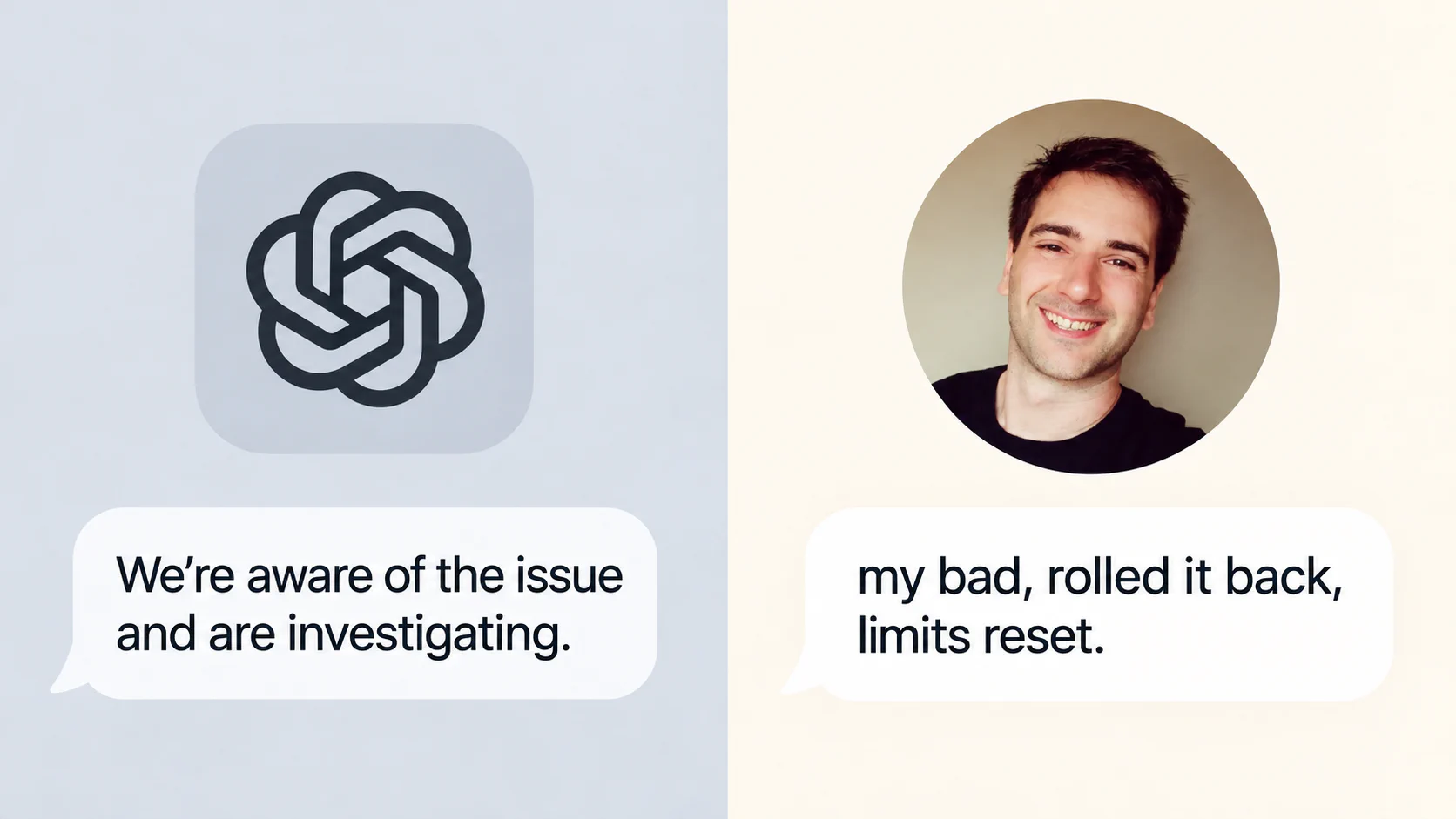
Power users of either Codex or Claude Code tend to follow a few specific people online: Thibault (Tibo) Sottiaux and, until last week, Thariq Shihipar. Why? Because they work at OpenAI and Anthropic and are the first to publish new features or usage-limit resets, which are very important for token-starved vibecoders like myself.
Employee-powered comms is one of the hottest trends in public relations now. Every startup wants its engineers posting on X and its PMs posting on LinkedIn. Warp and Corgi made it a big part of their marketing, albeit in a fairly artificial way.
Many companies want the benefits. Few understand why it works. And most copy the wrong part.
The people with the reset button
Both of the largest AI labs heavily rely on running their comms through employees. Sam and Dario are there only for the higher-level messaging. They communicate with politicians, regulators, bankers, and regular people. Their mission is too big to get bogged down with specifics.
That’s why they have dedicated product people who can interact with the audience directly and share technical details and announcements. I suspect plenty of developers don’t follow OpenAI or Anthropic’s accounts at all but have notifications on for people like Tibo or Thariq.
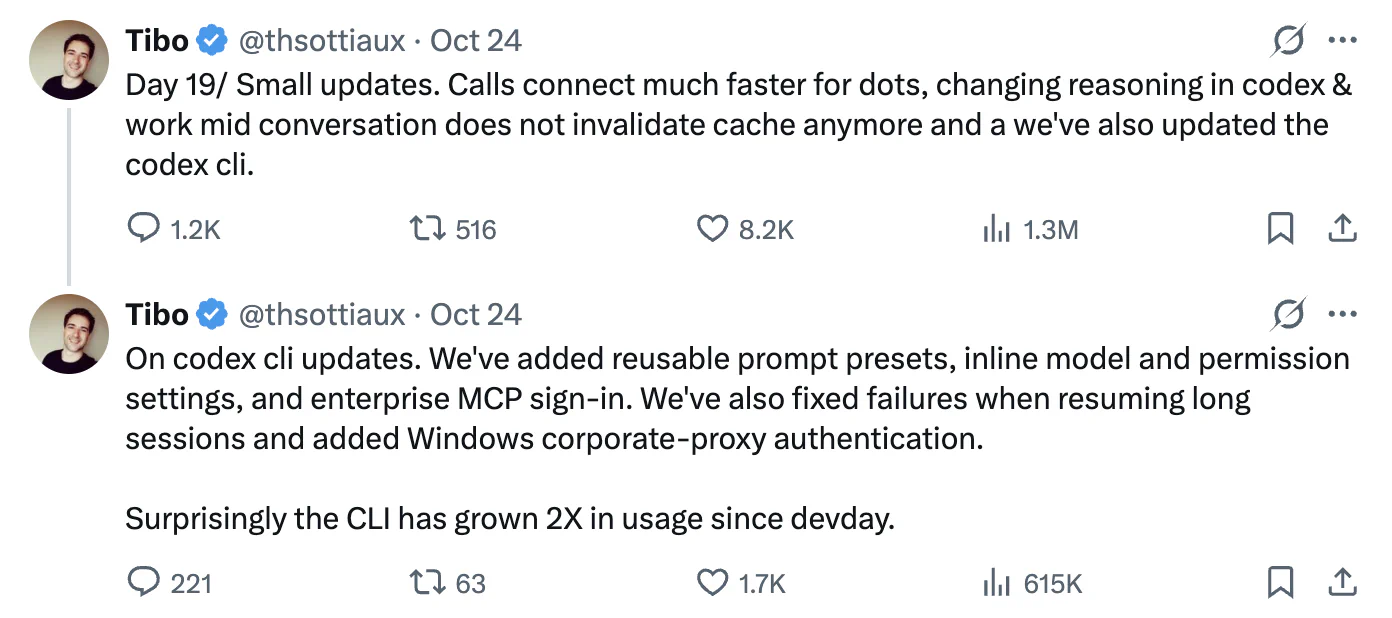
Tibo runs Codex. He announces features from his own account, replies to people complaining about bugs, and resets usage limits when something breaks. By one count, almost a hundred of his posts mention a reset. Fans built dedicated monitoring channels and even TiboGPT, a site with a single question: has Tibo reset Codex limits? The answer has been stuck on “Probably” for months.
Thariq was his equivalent at Anthropic. He was one of the most active members of the Claude Code team on social media, answering users and explaining policies. When Anthropic’s docs implied people couldn’t use their subscriptions in third-party tools, Thariq was the one who explained what the company meant and then apologized for the confusion. He left Anthropic on October 24.
Boris Cherny, who created Claude Code, plays a different role. He mostly does interviews and long threads about how his team works. One of them, in January, got millions of views. And Claude Code, together with the agentic models behind it, started the AI moment we’re in now. Anthropic’s run-rate revenue went from about $9 billion at the end of 2025 to $47 billion in May, and a reported $65 billion by summer.
When something breaks, users want to talk to someone who can fix it, not a faceless account hiding behind corporate language.
People trust people, and they trust the people who built the thing most of all.
Who else does it well
It’d be silly to skip the fact that both OpenAI and Anthropic are giant companies whose products are collectively used by over a billion people. Even their employees can get hundreds of thousands of followers. For most startups, it’s difficult to make anyone care even about the founders and what they have to say.
But you don’t need a billion users. What you need is the audience that cares about what your people know. For a lot of B2B startups, their customers aren’t on X anyway. But the engineers you want to hire might be, and so are the investors and reporters. That’s the reason to be doing employee-run comms: to reach those audiences. Your employees have interesting problems to talk about, and that’s a good start.
Before I go on, I’m leaving out three categories.
The first is founders. Plenty of founders are great on social media, and that’s a separate story I covered before. Being visible is the founder’s job today.
The second is manufactured influencers. Raffles for posts, AI-drafted captions in “your voice,” engagement pods where the whole company floods a post in the first hour. They pump up impressions and destroy trust. You know the companies I’m talking about here.
The third is developer relations. Most companies have a handful of anointed advocates whose job is to talk to customers: tutorials, livestreams, conference talks. Some of them are excellent at it, and people like Logan Kilpatrick even carried their audiences from OpenAI to Google. But an advocate can only pass your complaint along. They don’t own the thing that’s broken, so they can’t fix it.
So who does it well without paying anyone to post? Outside the two labs:
- Cursor. In 2025, Cursor hired Lee Robinson, who had spent five years building Vercel’s developer audience. He now explains Cursor’s product and teaches people how to use coding agents, much as he did for Next.js. He brought his audience with him. And while he’s definitely close to the definition of a developer advocate, he also worked on Cursor itself. SpaceX agreed to buy the company in June.
- The Browser Company. This team rebuilt marketing and acquisition tactics for a consumer tech product. One of the more unusual things they did is how much they put specific employees forward. Every Thursday release came with videos of engineers filmed in their apartments, explaining the features they had just built. With around 120 people, it made a browser feel like a product with a face, and it carried the same energy into Dia, which I can’t stop using.
- Stripe. Patrick McKenzie (patio11) was one of the early team members on Stripe Atlas and, by his own estimate, wrote more than half of the words on Stripe’s website. But his own essays had little to do with Stripe. He’d been writing about software businesses for years before he joined, and kept writing about payments, banking and Japan. He couldn’t fix your integration, but he understood how money moves, and that gave Stripe more credibility with the kind of customers they wanted.
- Cloudflare. Its company blog is written by the engineers who build the product. Anyone can pitch a post, and the approval chain is almost nonexistent: for years the CTO, John Graham-Cumming, read every technical post himself, legal turned reviews around within an hour, and the comms team stayed out of it. What they got from this is trust and speed. When Cloudflare took down half the internet on November 18, 2025, Matthew Prince joined the incident call, wrote the first draft of the postmortem at home that evening, and shared it in a Google Doc with a list of open questions. The engineers answered every question within a few hours, the San Francisco team did a final read, and the postmortem went live less than 24 hours after the outage was resolved. Gergely Orosz called it “moving with the speed of a startup, despite being a publicly traded company.”
Lovable often comes up as an example of employee-led comms too. To me, it’s a pretty mixed case. Elena Verna, its head of growth, was hired partly because she had a huge audience (in addition to being a great professional in her space). Lovable also runs a Slack channel called “bee swarming” where employees drop their posts so colleagues can pile in. It works for reach, but it’s closer to a growth hack than an employee replying to customer complaints on X.
What they have in common
They can fix things. This is the most important thing. Tibo is popular because messaging him actually gets things done. He can reset your limit, or at least explain why something was changed in the app. A community manager whose only responsibility is writing replies won’t cut it. Every company has one.
It’s a lot of replying. The announcements get the attention, but the grunt work is answering people. Essentially, you’re running human-facing customer support.
It’s specific. These people often share workflows, numbers, architecture details, postmortems. Nobody follows an engineer for their opinion of the company’s mission. There’s a place for this, but most of your content has to be around the product and tech.
Nobody approves every post. This entire approach works only if people can post on their own without approval. The company has to trust them to know what’s confidential or sensitive enough.
There’s a product people care about. AI coding tools are the most argued-about products in tech right now. Cloudflare’s outages take down half the internet. You have to behave exactly the same even if your product is still small (that’s how you grow it). But be realistic about it.
Employee-based comms have their risks. Look at Thariq: he left Anthropic, so now Anthropic has to rebuild communications around Claude Code, since his audience left with him and you have to follow somebody else for real-time updates. But generally, benefits outweigh the negatives.
Delivering bad news
There’s a less flattering side to all of this. Sometimes, companies use their employees as a shield when the audience gets angry, so employees step in to absorb the damage to the brand.
In July 2025, Anthropic announced weekly limits for Claude Code from its corporate account. In February 2026, it changed its docs to say subscriptions couldn’t be used in third-party tools. In August, the official Claude Code account announced a 25% increase in weekly limits. The same day, a temporary 50% boost ended, which made it a net cut for active users. Thariq spent a good part of February explaining what these changes actually meant and got a lot of pushback.
It’s natural to keep controversy away from corporate accounts, which politicians, experts and reporters watch closely. The company gets its formal announcement on record, and users get someone to argue with. But it means your employees’ credibility gets spent on decisions they didn’t make. Do it too often, and the person everyone trusted will become the person everyone hates.
How to do it well
If you still want to run employee-based comms, here’s how I’d do it right now.
- Hire for it. Ask candidates what they’ve written or built in public. You can’t train an audience into someone in a quarter.
- Let whoever shipped it announce it. The engineer or PM posts from their own account, and the company account quotes them. It’ll get more engagement anyway.
- Give them the power to fix things and talk about it. The best content employees can produce for you is “fixed, here’s what happened”. People must have the authority to do this and write about it.
- Write a one-page policy. You should provide your employees with a handbook that includes your basic company messaging and a guide on what they shouldn’t mention categorically: unconfirmed dates, unreleased products, customer names, financials, security details. The important default is that everything else is pre-approved.
- Feed them material. Give them early access, internal usage data, demos, and numbers they’re cleared to share.
- Publish your failures. A well-written incident report from the engineer who fixed the problem will do more for you than another launch post.
- Accept the tradeoffs. Some posts will be off-message. Some people will leave and take their audience with them. That’s the price of having people speak for you. Just take it.
Most companies fail at one of these. They hire people who neither have enough agency nor believe in the mission. And even if they do, the executives keep a tight leash and don’t allow them to communicate independently, trying to impose a centralized planned economy of attention (which never works).
People trust people. Let them talk about their work.
Get the next edition
Subscribe for new editions of How They Became Known, featuring deep dives into how technology companies gain attention and establish legitimacy online.
Recent Posts