The Age of the Polymath
You don’t need to write code. You need to know what code can do.

I’ve tried working in so many areas. I used to code and wanted to become a developer. I did a bit of design. I love photography. I did venture investing. The outcome of this is a career as a generalist. And being a little bit of everything sometimes felt like a disadvantage because the world rewarded the people around who went deep on something.
It turned out the breadth was useful anyway. I could talk to anyone and translate the ideas between engineers, executives, and reporters. That’s what I’m doing daily working in comms. But I always wondered what I would have built if I’d just picked one thing.
Not anymore. Because using AI and agentic engineering to their full potential requires having at least the basics of all those skills simultaneously. The things I knew a little about — code, design, copy, marketing — suddenly composed and compounded.
“An app designed by a developer” has been a meme for a reason. You’ve likely seen them and used them. They exist because developers know how to code and build software, even if they don’t know how to design it. As long as the app was uniquely useful, people would take it anyway. Meanwhile, designers couldn’t build much on their own. PMs can’t do much without either role.
With AI, the breadth of knowledge finally pays off. What matters is having ideas and applying taste, Rick Rubin-style. You no longer have to be an expert in all of these areas. But you must come up with ideas to build, and it’s up to you how great they turn out.
In my view, vibe-coded apps can be extremely polished and pleasant to use. In fact, far better than 90% of the software you might have on your computer or in your browser. Apple’s platforms have long had a culture of small, polished apps and tools, but even those are quite rare these days. And most web apps are quite primitive, especially in the B2B space, which is why companies like Linear have been so successful.
For the best result, it definitely helps to know what NextJS, Tailwind, Postgres, and many other words mean. Agents can make all the choices for you, but if you can’t evaluate them, there could be issues.
Any time I’m building a new side project these days, I get it to a place where I’d feel great releasing it to the public, even if it’s just for myself. I just can’t do it any other way. That means a polished UI, animated interactions, fine-tuned light and dark modes, beautiful custom icons, etc. I use these apps daily, so I want them to be great.
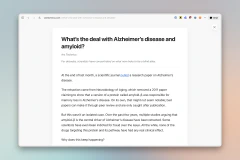
I only stop short of releasing the app when there are specific reasons. I’m writing this post in Elsendo, a web-based note-taking app I created with shareable links. That implies both server costs and an infinite potential for illegal content from piracy to CSAM. That’s not something I want to deal with in a free app and since it’s minimal, I’m not sure many people would pay for this, although the new owner of Evernote presumably believes it’s worth $250 a year. But I wanted this exact thing for years, nobody built it and now I have it. It’s open source.
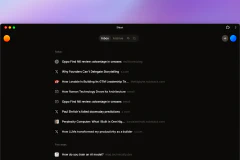
Gathering fascinating bits and links is my favorite thing ever, which is why I’ve recently built Mimir, a knowledge management app that aggregates articles, links, highlights, and more in one app. It has browser extensions and connects to X and Readwise APIs. Add Stripe, and it’d be ready to go. But it’s too heavily inspired by a few existing tools, plus I want ultimate freedom in how it will work. So it’s just for me.
This is the best part about building your own apps. Need a feature? You don’t have to wait or pester the developer, who likely has other ideas. Just build it. Some are harder than others but there’s a good chance the agent will do this for you. And running such an app for yourself isn’t a big burden. Occasionally, you see a bug and fix it. Over time, there are fewer and fewer of them. Or none.
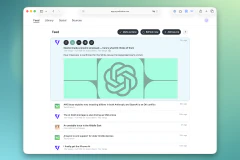
Most of my things are public. Since the previous post on this, I launched Syndicator, my intelligent RSS reader (think of it as a modern Google Reader replacement). And there are smaller tools and utilities, like a fast natural language timezones converter or MacPod, a virtual iPod that controls music on your Mac’s screen. I love reading Hacker News sometimes but never liked their 2000-era website or any of the third-party clients, so I built Hack and Cheese.
Some of those were built in 30 minutes on a Sunday evening. I usually had to spend more time on polishing in the next days but I continue using it, so polishing, adding obvious features, and fixing bugs is a good way to spend time for me. Because I actually enjoy this process a lot!
Here are some things I learned.
***
Models. Opus and Codex have never been closer, but Opus still excels in design. It’s a pricier option in terms of limits, so you can ask Opus to plan the app and create visual mockups of the interface, then ask Codex to build on top of them. Without supervision and hand-holding, it adds too many gradients, uniform buttons, useless text labels, and other noise.
Agents. I read about people who just build things with OpenClaw and don’t understand how they do it. Yesterday, I finally pulled the trigger on building my own little Pinterest and decided I’d just give it to OpenClaw. Despite using the same GPT 5.5 model as Codex, it ignored my mockups and made extremely silly choices, like wiring the context menu buttons to a POST delete request. Claude Code or Codex would never do something like this, so use them — the harness matters a lot.
Serverless. Vercel and Netlify are great platforms for little web apps because they are essentially free until you get big (but also rapidly become very expensive afterward, so be careful). You will also have to pay for most additional features, sometimes quite basic ones, like a database. Most of my side projects are hosted there.
VPS. Don’t be afraid of the VPS. Agents can set everything up and help you manage them. I recommend Hetzner because it is roughly three times cheaper than DigitalOcean today. Be mindful that the default agent behavior can expose vulnerabilities through open ports and user-accessible APIs. And on a VPS, all those problems will be exploited. The first time I launched a server, it was taken over by a mining bot in about 10 minutes. My best practices for deployments are in agents.md now. Push your agent to think about it and close the ports.
You can also take any local agent or OpenClaw and ask it to pentest your app. Then use this report to fix things.
***
The rise of agents poses many interesting questions we can’t answer yet. For one, it definitely seems that the value of these vibe-coded apps is unproven. Some become more popular than others and get engagement, but as a few creators noted on X, competing is extremely difficult because “competitors” can copy most of your features the next day. Everyone is building a Markdown editor these days (I also have my own). Yes, it’s become easier for you, but also for everyone else. So you can only win through superior distribution, attention to detail, or by making apps that do truly complicated things nobody can repeat with two prompts.
Scalability is another question. Every other month, Vercel generates a social media story about some creator getting a crazy bill, and then the CEO has to come down personally and void it. But the apps at least scale and work. If you create something that gets millions of users as a monolith on a VPS or AWS, can agents help you scale it?
Finally, we’re seeing more and more people in all roles being pushed to contribute to the codebase. Designers, PMs, and non-technical CEOs themselves are getting into development. It will clearly become an expectation for most people in tech companies, but does it mean the wall around software development as a role will become more permeable as well, or not?
It’s an extremely interesting and exciting time. Especially for polymaths. I know the word was (is) overused in Silicon Valley and is too generous for this concept, but no better word exists. And yes, there are true polymaths out there, people who can build delightful full-stack apps with great design and copy without any AI and I’m fascinated by their ability.
But if you’ve always known just a little code, a little design, a little writing — this is a great moment for you. Because you don’t need to know how to write code, you just need to know what code can do.
We’re in the age of the polymath.