How to Solve AI's Messaging Problem
Generative AI has a messaging problem. Can it be solved?

Today, AI is being framed as an entity that takes away things: jobs, chips, energy, water, or even creativity. Right as the major labs are about to go public.
It has become such a divisive technology. Tech founders and executives love AI. Developers are split. There’s definitely a certain share of people who publicly despise it, ready to dismiss any piece of content that has a trace of artificial intelligence, even if they use it themselves. At the end of it, Claude, ChatGPT, and Gemini are still the most downloaded apps — most people continue using them and are doing this more and more.
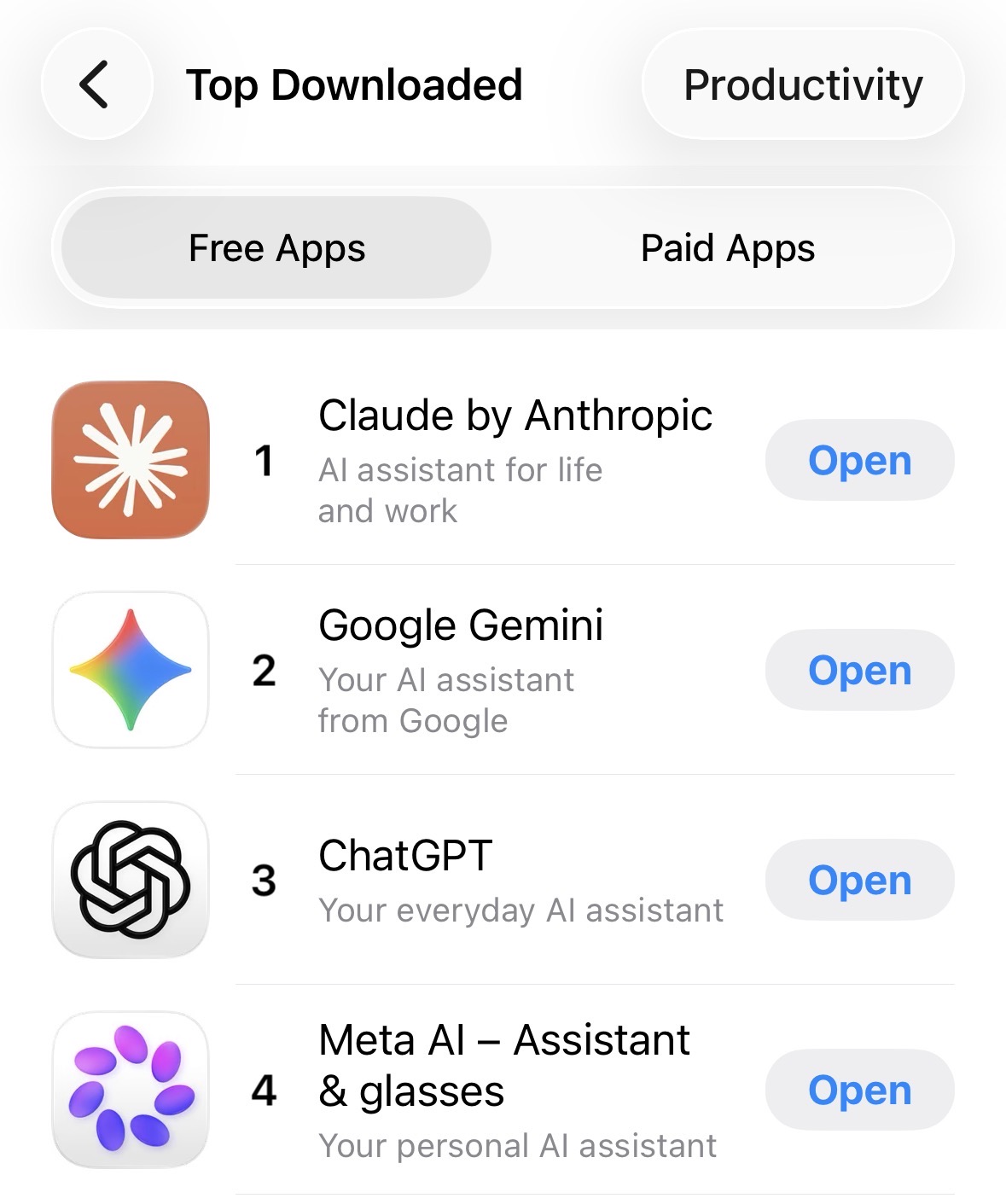
It could be a loud minority, or a case of stated vs. revealed preferences, but this phenomenon exists, and if you want to communicate about AI, you must understand it.
AI labs and hyperscalers should take a page from many other industries who had negative externalities (sometimes far bigger ones) and rebuild their public messaging.
Jobs and Layoffs
AI labs have largely brought it on themselves. By vocally discussing the long-term effects of AI on employment and society and issuing scary statements, they gave everyone out there the fuel for talking points. People are naturally anxious about their future, and whether they will have a job is a big part of it. Claiming that AI will eliminate half of white-collar positions doesn’t win you political points, even if it might juice your IPO a bit.
One of the worst aspects of the AI debate is that many companies are now using AI to justify layoffs. Amazon cut 14,000 corporate roles last October and another 16,000 this year, explicitly tying the restructuring to AI. Salesforce shrank its customer support org from roughly 9,000 people to 5,000, while Marc Benioff boasted that AI now handles half the work. Block’s Jack Dorsey said headcount would fall by nearly half as AI boosts productivity. Webflow, Meta, Cloudflare, Chegg, CrowdStrike, and Pinterest have all done layoffs with the same explanation.
These CEOs are now saying that the same companies can be run by far fewer people with AI at hand. The white pill is that they could always run them with fewer people without any AI at all. As a manager, you have many incentives to hire and few to avoid bloat. “AI did it” sounds better to investors than admitting you over-hired or that demand is low — ultimately, it’s AI-washing, but the messaging they use harms the AI industry.
This is the hardest part since everyone is doing this, and you can’t really stop it. Also, at this point, no single person or entity has control over the future of AI as it is. The frontier labs’ capabilities are pretty similar, as they are in a Red Queen kind of race with each other. If OpenAI alone commits to something, it’s on them. Even politicians and countries can’t do much more. If tomorrow the United States’ Congress passes a law to prohibit AI development or replace jobs with AI, China will proceed and, in 6 months or so, reach parity with the last generation of frontier models.
What should you do? First, stop talking about job loss; it only adds to already-high anxiety. It’s undeniably true that every major improvement or automation has always eliminated certain roles, from elevator operators to the 80% of people once working in agriculture, while creating new ones. And new professions that emerged would sound fictional to someone from the 1800s.
While you might find that story reassuring, it’s too abstract to defend any specific job at risk right now. It can be a good data point for experts and analysts who’d be reprocessing and distributing it, but if you’re an AI lab, you need something else. Instead, focus on concrete, down-to-earth AI applications.
When tools like Claude Code or Cursor make it easier to build websites, agencies that once relied on Webflow will simply switch to them. But somebody still has to build those. Some businesses and products might fail, others will flourish.
Run research and surveys, because most people using AI already say they feel at least as busy as before, echoing how the printing press didn’t just let Europe produce the same number of books more efficiently, but radically increased output, a pattern likely to repeat this time as well.
Some jobs are genuinely demeaning, and automating them is a net good if paired with stronger welfare support, which demands a discussion. And some carry massive negative externalities, like driving, but you need to start lobbying yesterday to fight the entrenched driver unions that can delay safer self-driving systems such as Waymo, even as tens of thousands of people die in car accidents in the US and hundreds of thousands globally each year. AI is our best shot at dramatically reducing that toll, but you need to make that case or find someone who does.
But most importantly, avoid radical apocalyptic statements. That’s a start.
The Physical World: Construction, Water, Energy
AI also has tangible physical applications that consumers experience directly. The exponentially growing demand for inference has decimated the supply of RAM and SSDs, leading to some of the most drastic hardware price surges. For the first time in history, consoles have increased in price after release, with some, like the Steam Deck, rising by 40%. It’s prohibitively expensive to build a home PC now. And even phones and laptops will be hit. This is also an area AI labs can’t really fix. Only three companies can produce leading-edge RAM: SK Hynix, Micron, and Samsung — and their lines are busy making HBM chips for GPUs.
There’s also the datacenter buildout. The planned CAPEX for the hyperscalers alone, meaning companies like Amazon, Microsoft, Google, Meta, and Oracle, is projected to be at $660–690B for 2026. It was $162Bn in 2022 — a 4x growth. If we look at datacenter construction, it grew from $9B a year in 2020 to approximately $41B in 2025, and the annualized rate passed $50B in April 2026 — now represeting 2.3% of all US construction.
There’s nothing objectively bad about construction. Construction creates jobs and drives growth, yet it’s still often demonized and opposed by local governments and activists across Western countries — it’s a general problem that requires its own solution. To be specific, let’s look into two claims about data centers regarding water and energy.
The “Empire of AI” book included incorrect calculations of its water usage, which are now parroted everywhere. Agriculture consumes far more water, often for not exactly the most reasonable things, like growing almonds in the desert. Well, look at this awesome website from the California Almonds defending the practice. Agriculture does many worse things with water and has learned to defend itself in public. There are many such industries that have their own playbooks. Every data center needs such a website. Where are they?
Farming also puts pesticides into water, and then data centers are blamed for processing that water. Since a small amount of it evaporates, technically, the concentration of pesticides (or anything else in the water) increases, even if it’s not their fault. And politicians will be riding this wave to grow their own popularity, even if that means that data centers are like 1940s-level factories that poison the ground and the water around them.
AI companies should have reacted to that topic far quicker, but there’s no time like today — Google and Microsoft are finally doing this. Google published a blog post saying it will replenish more water than it uses at its data centers by 2030, invest in local water infrastructure, identify alternative water sources, and be transparent about its overall water use. Microsoft announced that its next-generation AI data centers use closed-loop cooling, consuming nearly zero water for operations. But being late means they risk public moratoriums on data center development.
Note that they don’t confront the unreasonable claims about AI water usage directly; that’d be futile. Their target audience won’t be receptive to this anyway. So instead, they’re acting as responsible adults and simply commit to things that should be reasonably simple. Make boring commitments, don’t argue on Twitter.
Activists measure air quality near Colossus, a gas-turbine-powered facility, and present the results as a catastrophe, even though no figures existed before the turbines came online. They’re comparing something to nothing and calling the difference a disaster, which is not how measurement works. Tech companies should perform those measurements themselves in advance to have a reference, commit to using the cleanest source possible, build their own generation, and be transparent about actual usage.
Gas turbines are used because there isn’t enough power near these data center sites. US energy generation grew by around 7% over the past decade, but that was entirely due to population growth, while per capita energy use remained flat. Per capita generation rose from 12.7 to 13.0 MWh (about a 2% increase over 10 years), and it had been declining through 2023 before the AI-era uptick reversed that decline.
Data centers are great customers for energy producers that allow them to invest in generation and the grid, since data centers demand a constant and reliable load that you can account for over the years.
But scaling energy in the current environment is just harder, which is why companies are trying weirder things. Microsoft will buy energy from Helion, Sam Altman’s fusion startup. It’s a bit far-fetched, so they’re not immediately touting this as a solution, which is probably the right way forward.
Hyperscalers and data center developers should make the same commitments to energy as they do to water, especially since energy prices are more dynamic and consumers are sensitive to them. Commit to cleaner solutions, provide timelines, foot the bill for the infrastructure development, negotiate, and pay more so that the market rates aren’t affected. Explain how your investments will make the energy cheaper and more reliable. Then, post intensively about this so that at least some people get the idea and argue for you.
A Playbook for AI Messaging
Let’s get back to the statement at the beginning of this post. If you’re an AI lab, right now your job is to flip the conversation about AI. It’s framed something that takes jobs, chips, energy, and water. Instead, you need to position it as something that multiples all of those things.
Focus relentlessly on specifics. Talk about how AI creates jobs. How AI can help in chip design and manufacturing. That AI helps produce more energy by stabilizing the demand. Or enables investments in water and sanitation. Make the case that AI makes life better
That’s what every corporation did for centuries. You don’t come into a city with a promise to eliminate all jobs. You tout how many high-paying jobs you will create. Unlike most businesses, AI labs didn’t need anyone’s permission to build and deploy their models at first. But they do need compute, and with datacenters it suddenly becomes physical enough so people have a say in it.
AI will create new roles. If more people can build workflows and software without learning how to code, it doesn’t mean we’ll need fewer developers. We will need far more of those new yet-unnamed roles. When something becomes cheaper and more accessible, the world tends to want more of it, not less.
Spreadsheets and SaaS tools made accountants more productive, yet the number of accountants didn’t collapse. Here’s a chart showing the number of accountants in the US. For some reason, it doesn’t just go down to the nil: ups and downs correspond to financial crises, not technology advances.
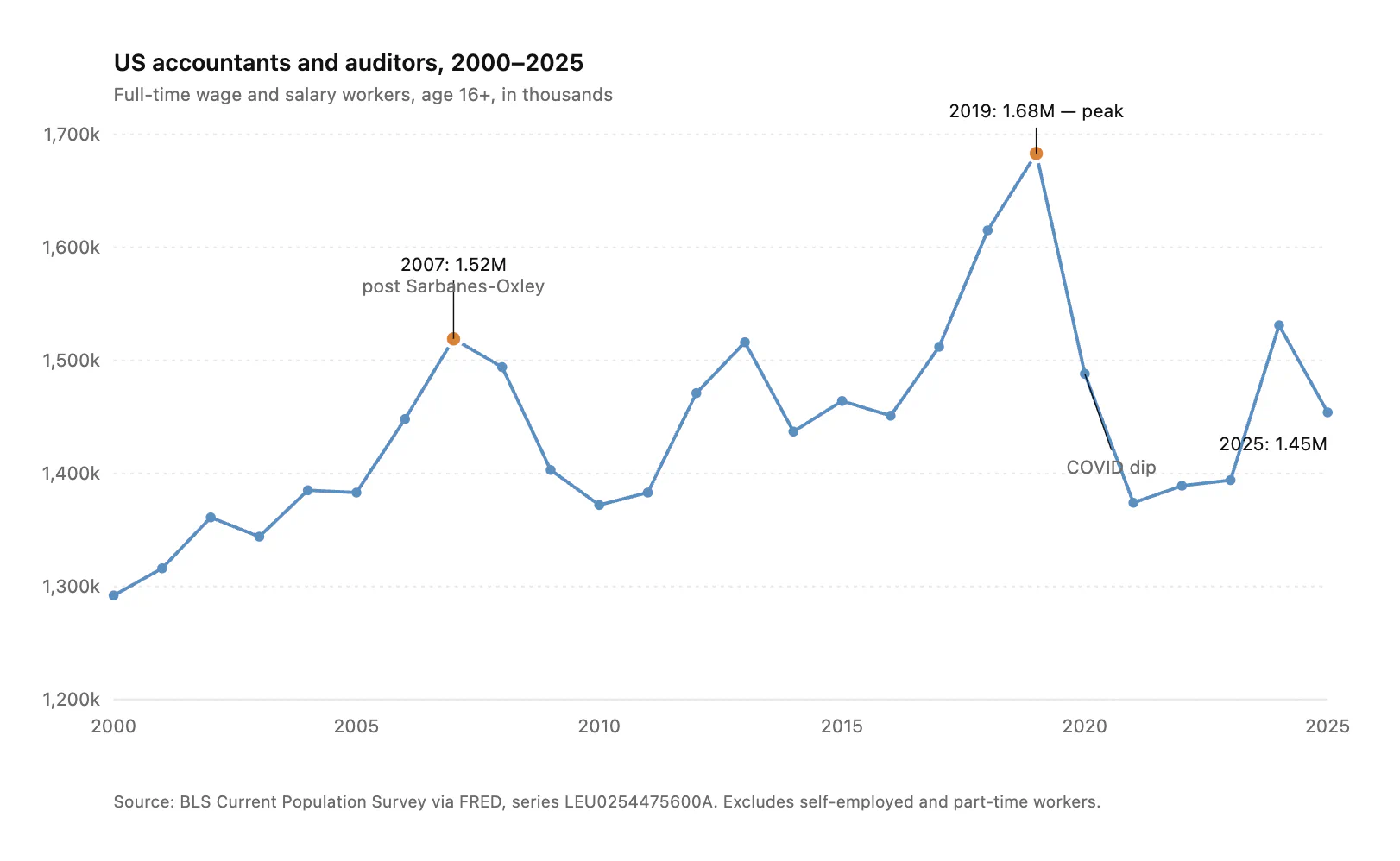
What AI labs truly need is a positive vision for the future. And it has to be near-term, not about AGI solving all problems while people thrive on UBI. Creating more jobs, better jobs, is the minimum required.
Don’t predict the end of work. And on the physical side, you will not win an argument about water or power on Twitter, but you also can’t be silent.
Talk strictly about workflows and capabilities: what your models enable that was previously difficult. Push the idea that most users report being at least as busy as before, just working on more ambitious and creative things, and run research to confirm this.
Position energy and water are infrastructure problems you are helping to solve, not something you hope nobody would notice. Commit to becoming more efficient and neutral, and to improving the lives of the residents in these towns by providing more energy and cleaner water, while arming your supporters with numbers and talking points based on research into your actual footprint.
You still won’t convert the loudest opponents, but you can create a much saner story, and that’s what matters.